

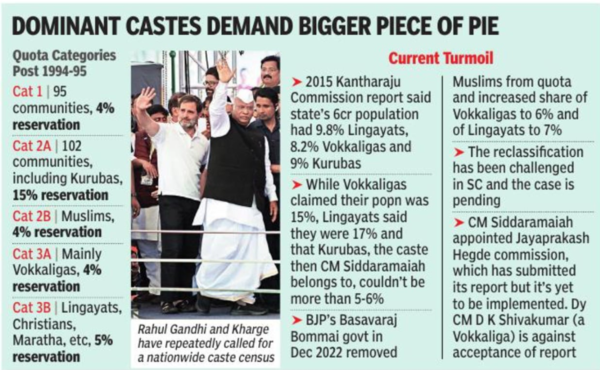
In fact, the action in Karnataka precedes the demand for a caste census by Congress MP Rahul Gandhi and AICC president Mallikarjun Kharge, which came on the heels of a statewide survey in Bihar.
Responding to the PM’s criticism, Kharge told TOI: “While it is popularly being called a caste census, what we are proposing to do is a socioeconomic and educational survey that aims to assess and identify communities eligible for welfare schemes. We’ve already implemented several schemes like MGNREGA, which aren’t based on caste but on needs of all communities. Modi is making the issue communal solely for electoral gain.”
Karnataka has been at the forefront of the caste survey issue — much like with ‘guarantees’ this season — and a report on it was submitted by a commission headed by Jayaprakash Hegde, now Congress candidate from UdupiChikmagalur. The Siddaramaiah govt accepted the report but is yet to implement its recommendations.
Campaign plots of LS polls in Karnataka include the OBC narrative. If Siddaramaiah with his Ahinda credentials is Congress’s lead actor, BJP has been projecting PM Modi as the OBC face.
Shivaraj Thangadagi, Karnataka backward classes welfare minister, told TOI: “Our govt has done what none had before by accepting the report. Its implementation will not only benefit backward communities but also the party, for sticking to its commitment. The concerns of other communities will be addressed while implementing this.”
Union home minister Amit Shah and Karnataka leader of opposition R Ashoka have reiterated how BJP was with OBCs with Modi being “sabse bada (biggest) OBC” during their campaigns in the state.
Nationally, Nitish Kumar — who had commissioned the Bihar caste survey — leaving INDIA and Congress being concerned about caste matrices across states may have seen the party use the OBC card cautiously, but it has included it in its national manifesto, while BJP continues to actively woo these communities.
“Congress didn’t tolerate leaders from extremely backward classes. In 1987, Congress refused to accept Karpoori Thakurji as opposition leader whom we honoured a few days ago with Bharat Ratna. These days, Congress colleagues express concern about the number of people from backward classes in govt, where they’re positioned… But I’m surprised they don’t notice the biggest OBC (referring to himself),” Modi told Parliament on Feb 5.
The PM referring to himself as the biggest OBC came close on the heels of Rahul claiming that Modi’s Teli caste was not part of other backward classes.
National Scene
India’s first proper caste enumeration was under the British in 1931. Subsequently, while the Constitution addressed education and job reservations for SC/STs, the first independent govt realised there were numerous underprivileged backward commu nities, resulting in the Kaka Kalekar commission in 1953, which recommended a castewise census enumeration in the 1961 Census.
But it was Mandal Commission’s 1980 report that proved pivotal, identifying 3,742 OBC communities and recommending 52% quotas — though only 27% reservations were implemented by V P Singh’s govt in 1989 amid violent protests and legal battles.
A landmark 1993 Supreme Court judgment (Indira Sawhney case) capped overall reservations at 50% but allowed exceptions. It also introduced the ‘creamy layer’ excluded from reservation, based on annual income limits, currently Rs 8 lakh.
Karnataka Pioneers Mysore ruler Nalvadi Krishnaraja Wadiyar appointed the Leslie Miller commission to examine non-Brahmin underrepresentation in 1918, despite opposition from then Divan M Visvesvaraya.
Post-Independence, Nagana Gowda Commission (1960) recommended 45% job and 50% education quotas for OBCs, excluding Lingayats, which prevented implementation. Then, the 1975 LG Havanur panel raised the quantum to 32% across the three categories it introduced. But the exclusion of Lingayats again caused friction.
To address this, the T Venkataswamy commission was formed, which, in its 1986 re port, included some Lingayat sub-castes and, again, the 1990 O Chinnappa Reddy commission included Muslims, Vokkaligas and Lingayats, but the latter two were dissatisfied with the representation. This finally led to creation of a permanent BC commission, with the first in 1994 led by Kudur Narayana Pai.
The Chinnappa Reddy report recommendation was implemented in 1994-95 and has since been used as the matrix for reservations in the state.
And in 2015, CM Siddaramaiah set up the H Kantharaju commission to carry out a socio-economic educational survey, commonly called caste survey. While Siddaramaiah’s tenure ended before the report could be submitted, leaked contents created heartburn among Vokkaligas and Lingayats. Subsequent govts didn’t accept the report citing reasons, including a technicality that the membersecretary hadn’t signed it. This prompted the Jayaprakash Hegde commission to revisit the Kantharaju panel report. The Hegde commission has since submitted its report to the Siddaramaiah govt.
In between, BJP’s Basavaraj Bommai govt had in Dec 2022 rejigged the categories based on which existing reservation was being implemented. It removed Muslims and added an additional quota for Vokkaligas and Lingayats. But its implementation is stalled as a case is pending before Supreme Court.
Credit: Source link