

Premium
Unfortunately, any fear of the harmful effects of pollution is second only to the pleasure of carrying on with business as usual
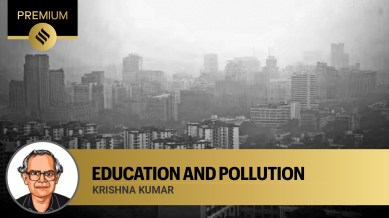
The children had rehearsed the sports day rituals in the playground. So, despite the awful pollution, they were told to go through the programme outdoors. Neither the principal nor the physical education teacher saw the implications of this decision. Changing the programme wouldn’t have been exactly an earthshaking or embarrassing reversal. It would have been the right step if children’s pulmonary health were a concern. And no one would have denied it had the question been posed, let us say, by a journalist. Then, why wasn’t the plan changed? The answer might be that “it was just a matter of two-and-a-half hours and children would be disappointed if the sports day were to be postponed.”
No one on the staff could suggest such a change. The school’s authority structure doesn’t brook such a possibility. If the science or math teacher or other senior members of the staff had dared, they would have been pacified with a casual answer like “Oh, it’s just for two hours”. They wouldn’t have persisted because it is none of their business. And, if they were worried about their own lungs, they were free to miss the function. For the science teacher to anchor her argument in her knowledge of particulate matter and the life-long danger it presents for children’s lungs would have been seen as showing off. When the principal is around, no one has a say, even the vice-principal. The principal is the ultimate leader. Her leadership can cover an emergency decision, but air pollution doesn’t seem to warrant it.


You have exhausted your
monthly limit of free stories.
Read more stories for free
with an Express account.
Continue reading this and other premium stories with an Express subscription. Use promo code DIWALI30 to get 30% off.
This premium article is free for now.
Register to read more free stories and access offers from partners.
Continue reading this and other premium stories with an Express subscription. Use promo code DIWALI30 to get 30% off.
This content is exclusive for our subscribers.
Subscribe now to get unlimited access to The Indian Express exclusive and premium stories.
What about the parents? Why didn’t they object? In most cases, they are simply too scared to complain about a plan the school has put out. The fear that someone who objects to the school’s decision would be asked to withdraw his or her child from the school is quite real. As the macabre drama of a grand sports day unfolds in dense, smoky air, everybody is supposed to clap and click pictures. Cribbing on such a wonderful occasion will be seen as an outcaste’s behaviour.
Pollution matters, but not enough to force a pause, let alone a change of course. It is like the landslides and floods in Himachal. The devastation they caused raised great concern, but not to a level that might bring about a change in policies, and certainly not enough to cause a reversal in decisions already taken. During a recent visit to Himachal, I saw how quickly the four-lane highways and flyover projects had been resumed. More such projects are now being presented as if the disasters experienced in the Manali area are now merely an unpleasant memory. The four-lane highway to Simla is an unending story. Those who believe in its correctness see the frequency of roadblocks as teething troubles. They have to be endured with courage, say the believers in the dream of tourism-based growth of the hill state’s economy. In Uttarakhand too, projects that involve blasting of the fragile Himalayan hills are moving along nicely. The tunnel that has partly collapsed trapping labourers inside is the latest instance of nature’s failed pedagogy. The tunnel is meant to bring Gangotri closer to Yamunotri in travel time.
The problem with environmental decay is that it is incremental. Dramatic events such as heat waves and floods tend to pass after displaying their fury. They don’t necessarily settle the kind of debates that terms like “climate change” and “development” entail. Moreover, the overall change in the state of the environment is often a victim of subjective assessment. An older person might register a shift in the pattern of seasons or soil quality whereas a young person may simply take the present scenario as the only reality he or she knows. Fortunately, education has induced a considerable number of young people into a community of the concerned. This community is not exactly vast in our country. Also, it faces the daily hype of growth and grandiose achievements. Something as basic as air or water seems rather banal as a source of anxiety when a breathtaking future is supposed to be unfolding. Neurosis often turns out to be the only equilibrium possible in the middle of heated, polarised discussions. They dominate the ecosystem of discourse while the real ecosystems descend to yet another level of irretrievability. Indeed, the term “ecosystem” has been successfully hijacked. Its avid users believe that every crisis, including that of the environment, offers an opportunity.
Most Read
Alia Bhatt says she ‘broke down’ after seeing Raha’s photo online in Kashmir, Ranbir Kapoor ‘pushed his work’ and rushed to pick her up
Tiger 3 box office collection Day 5 early reports: Salman Khan film dips further, expected to earn over Rs 17 crore


The relentless entertainment culture does not stop for air pollution or even acknowledge it. The day Delhi’s air quality index turned “severe” last week, Akashvani’s Rainbow channel on FM radio covered Delhi Haat in its live reporting slot. In it, the anchor who sits in the studio talks live to a roaming reporter. He went on and on about the joy that the diverse menus of different eateries at the Haat were offering to visitors. Not a word was said about the horrible air they were breathing. Nor did the anchor ask her roaming colleague to find out how the visitors felt about the smog. It was a glowing tribute to the “no negative thought” ethic followed on all FM channels, including the private ones.
The only people concerned about Delhi’s air quality are the doctors. They speak and warn wherever they are given space in the media. Apparently, their warnings don’t suffice to make anyone feel scared of poisonous air. Some school principals do talk about environmental problems in their morning assembly addresses. But when it comes to taking a hard decision, they flinch. Cancelling an open-air sports day function on a smoky day in order to protect children’s pulmonary health is one such decision. It might have great potential for dramatically driving home the importance of clean air, but even that possibility is second to the pleasure of carrying on the business of education as usual.
The author is a former director of National Council of Educational Research and Training
© The Indian Express Pvt Ltd
First published on: 18-11-2023 at 07:07 IST
Credit: Source link